


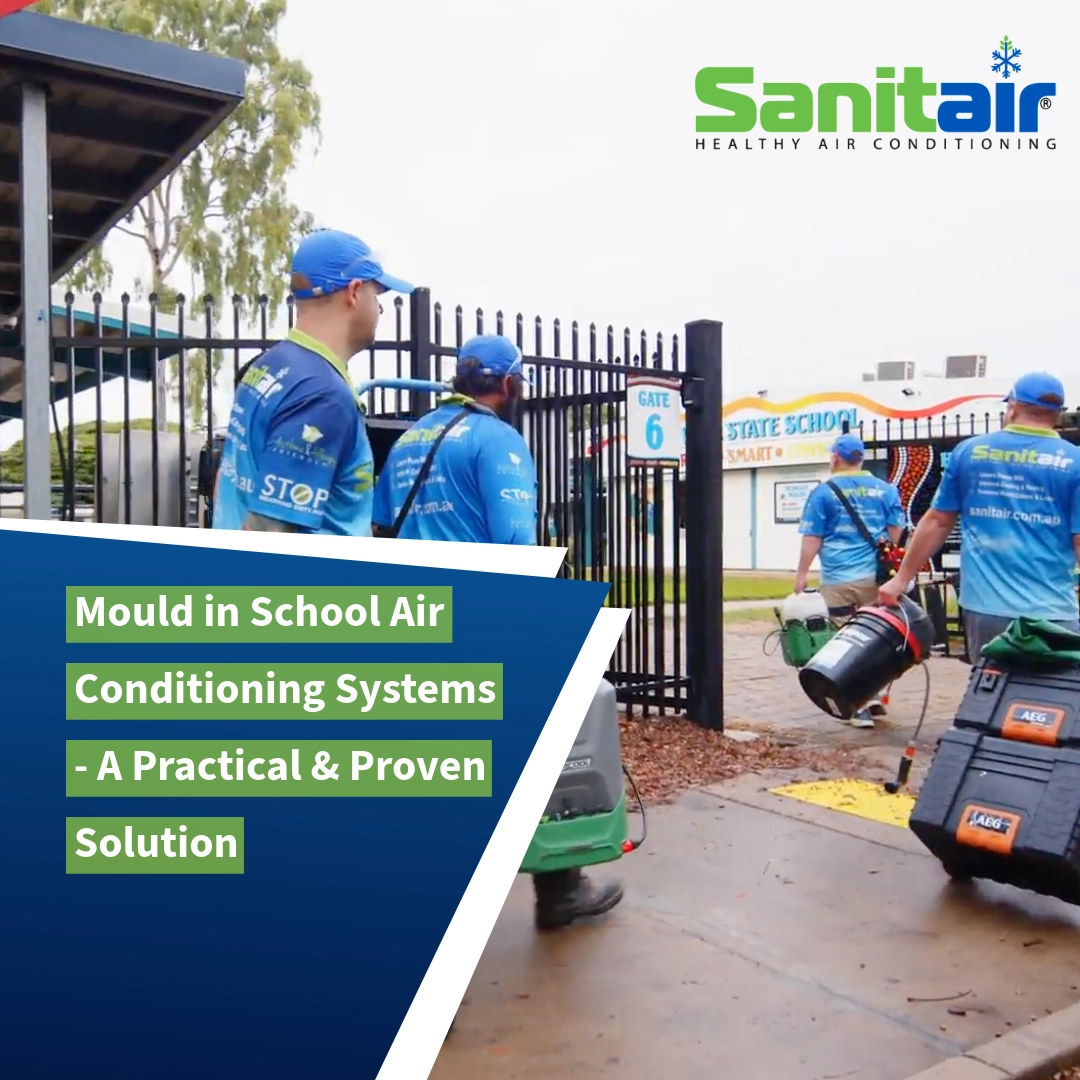
Mould in School Air-Conditioning: Why NSW Schools Need a Practical Proven Solution
Schools across New South Wales are under increasing pressure to deliver safe, healthy learning environments—without blowing out already tight budgets. Yet one of the most significant risks to student and staff wellbeing often goes unseen: mould growing inside air-conditioning systems and spreading through classrooms.
Sanitair has a proven solution tackle this issue head-on with non-toxic mould remediation, backed by a 12-month mould-free guarantee—all without breaking the budget.
The Evidence: Mould and Poor Air Quality in NSW Schools
Recent studies and inquiries make it clear that indoor air quality (IAQ) and mould in school HVAC systems are not hypothetical problems—they’re real, documented and in some cases severe.
1. CO₂ and ventilation concerns across NSW classrooms
The NSW Department of Education’s Clean Air Schools Program, run with UNSW Sydney between 2023 and 2025, monitored air quality in 59 public schools across Sydney, Newcastle and Wollongong. Key findings include:
· Most classrooms exceeded the recommended 850 ppm CO₂ threshold at some point during the school day, indicating periods of inadequate ventilation.[31][32]
· Three schools—Condell Park High, Hebersham Public, and Mayfield East Public—consistently recorded CO₂ levels above 1,000 ppm for much of the day, levels considered suboptimal for learning and health.[32]
· Classrooms with cross-ventilation and those in the Cooler Classrooms Program generally had lower CO₂ levels than those relying on split-system air-conditioning alone.[32]
While this study focused on CO₂, PM2.5, and NO₂, the underlying issue is the same: ventilation and HVAC operation directly shape the air students and staff breathe every day.[33][31][32]
2. Mould outbreaks linked to air-conditioning systems
Beyond ventilation metrics, several high-profile NSW cases highlight how mould can take hold in school buildings—and how HVAC systems can become part of the problem.
Willyama High School (Broken Hill)
In early 2024, an independent hygienist’s report found a severe (Condition 3) mould infestation at Willyama High School, so extreme that the building was recommended for complete demolition and rebuild.[34][35][36]
Key findings from the report:
· Human pathogens including Aspergillus and Penicillium were detected in the building.[36]
· The outbreak likely started in a ground-floor music room and spread through the air-conditioning vents across the building.[36]
· The report identified wet carpets, mechanical HVAC operation and lack of natural ventilation as key contributors to the moisture conditions that allowed mould to flourish.[36]
This case is not an isolated incident. Submissions to the NSW Parliament’s Clean Indoor Air Inquiry reference mould issues at other schools, including Fort Street High School and Main Arm Upper Public School and note that “mould in schools was not part of [the UNSW] report, but needs urgent addressing”.[37]
3. International research: HVAC systems as mould reservoirs
Australian experience aligns with international research:
· Studies in hot and humid climates show that elevated indoor humidity and poorly controlled HVAC systems lead to widespread mould contamination in schools.[38][39][40]
· Investigations of schools with summer mould outbreaks identify over-ventilation, over-cooling, and control-sequence failures in HVAC systems as recurring drivers of mould growth.[41][42]
· The U.S. National Academies highlight that microbial contamination of HVAC components—coils, drain pans, filters and ducts—can spread bioaerosols to occupants and onto previously clean surfaces.[43]
In short: when moisture, temperature and ventilation aren’t tightly managed, air-conditioning systems can become reservoirs and distribution networks for mould.
Why This Matters for Principals, Staff and Students
Poor indoor air quality and mould exposure are more than compliance issues. They affect:
· Student health and attendance – respiratory irritation, allergies and asthma exacerbations.
· Staff wellbeing and retention – headaches, fatigue and respiratory symptoms linked to “sick building” conditions.
· Learning outcomes – elevated CO₂ and poor IAQ are associated with reduced concentration and cognitive performance.[44][45][31][32]
· Facility costs – reactive mould clean-ups, temporary relocations and in extreme cases, full rebuilds like Willyama.[35][34][36]
For Principals and facility managers, the challenge is clear: improve IAQ and manage mould risk without overwhelming already stretched budgets.
Sanitair’s Approach: Safe, Non-Toxic, Budget-Conscious
Sanitair specialises in helping schools improve indoor air quality through targeted, non-toxic mould remediation of air-conditioning systems. Our approach is designed specifically for the realities of the public education sector:
· Non-toxic, safe treatments – suitable for occupied school environments with minimal disruption to classes and activities.
· Focus on HVAC hygiene – we treat coils, drain pans, ducts and other components where mould and biofilm commonly establish.
· 12-month mould-free guarantee – confidence that the work we do delivers lasting protection, not just a short-term fix.
· Budget-friendly solutions – practical options that fit within school and regional maintenance budgets, helping avoid costly reactive interventions down the track.
We work alongside Principals, deputy principals, facility maintenance teams and education departments to:
· Identify high-risk areas and systems
· Develop phased remediation plans aligned with school terms and maintenance schedules
· Provide documentation to support compliance, risk management and communication with staff and parents
Contat your local Sanitair HVAC Hygienist – 1800 130 168
Whether you’re managing a single campus or multiple sites, Sanitair can help you create healthier, safer learning environments—without compromising your financial plan.
Next Steps
If you’d like to explore how Sanitair can assist your school or region:
· Contact our team to arrange an on-site assessment of your HVAC systems
· Request a tailored proposal outlining scope, timelines and investment
Cleaner air, safer classrooms and long-term peace of mind are within reach—without breaking the budget.

1. https://nswsdpa.asn.au/news/2026-annual-conference-call-for-potentexhibitors/
3. https://hvacrnews.com.au/news/nsw-school-study-reinforces-iaq-concerns/
4. https://www.preenviro.com.au/victoria-mould-removal/
5. https://gcclean.com.au/mould-treatment-removal/
6. https://mouldandhygienesolutions.com.au/service/mould-removal/
8. https://unit444.com.au/services/mould-removal-odour-control/
9. https://airfiltersforschools.com/blog/indoor-air-quality-in-schools-expert-facility-guide/
10. https://www.wellioeducation.com/events
11. https://x.com/NSWSLI/status/1996416027421491203
13. https://mouldbustersmelbourne.com.au/mould-removal-for-government/
14. https://www.nswppa.org.au/enews?nid=81
15. https://mouldandhygienesolutions.com.au/location/mould-removal-central-coast/
16. https://onlinelibrary.wiley.com/doi/am-pdf/10.1111/ina.12403
17. https://web.ornl.gov/sci/buildings/conf-archive/2007 B10 papers/010_Morse.pdf
18. https://eta-publications.lbl.gov/sites/default/files/pdf_5.pdf
19. http://www.naylornetwork.com/asb-nwl/pdf/indoor_air_2014_energy_submitted.pdf
21. https://nap.nationalacademies.org/read/11574/chapter/5
25. https://www.epa.gov/mold/mold-remediation-schools-and-commercial-buildings-guide-chapter-3
26. https://files.eric.ed.gov/fulltext/ED464475.pdf
27. https://www.cdc.gov/niosh/hhe/reports/pdfs/2019-0156-3382.pdf
29. https://journals.indianapolis.iu.edu/index.php/ias/article/download/7415/7399/0
32. https://balgowlahnews.com.au/mackellar-girls-campus-takes-part-in-nsw-air-quality-research/
36. https://www.abc.net.au/news/2024-03-19/willyama-high-school-to-be-torn-down-and-rebuilt/103604552
37. https://thriveiaq.com/wp-content/uploads/2026/02/NSW-Clean-Indoor-Air-Inquiry_Thrive-Submission.pdf
38. https://onlinelibrary.wiley.com/doi/am-pdf/10.1111/ina.12403
39. https://web.ornl.gov/sci/buildings/conf-archive/2007 B10 papers/010_Morse.pdf
40. https://eta-publications.lbl.gov/sites/default/files/pdf_5.pdf
41. http://www.naylornetwork.com/asb-nwl/pdf/indoor_air_2014_energy_submitted.pdf
43. https://nap.nationalacademies.org/read/11574/chapter/5
46. https://nswsdpa.asn.au/news/2026-annual-conference-call-for-potentexhibitors/
50. https://www.seeleyinternational.com/us/hvac-case-study/hunter-sports-high-school-nsw/
51. https://www.wsws.org/en/articles/2025/08/08/epnx-a08.html
52. https://www.chiefscientist.gov.au/sites/default/files/2024-08/Indoor Air Quality Report 2024.pdf